

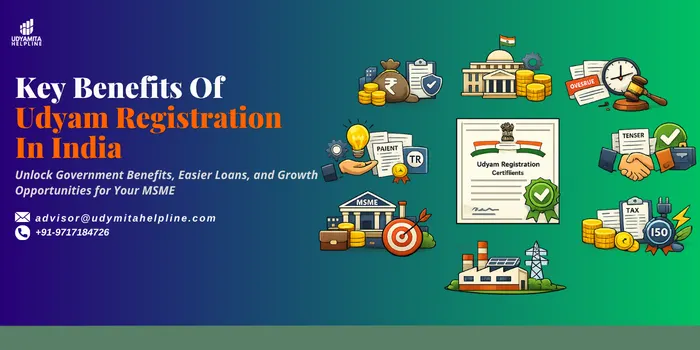
Let’s be real, running a small business in India is hard enough without missing out on benefits you actually qualify for.
And yet, that’s exactly what happens to thousands of MSME owners every single year. They work hard, they’re eligible, but they haven’t done one simple free step — Udyam Registration. So the government loans go to someone else. The subsidies go to someone else. The tenders go to someone else.
The Advantages of Udyam Registration aren’t hidden. They’re just underused. This guide lays them all out, plainly, so you know exactly what you’re unlocking — and why you shouldn’t wait another week to register.
What Is Udyam Registration and Why Does It Matter?
Think of Udyam Registration as your business’s official ID card from the Government of India.
Udyam Registration is the formal recognition process for Micro, Small, and Medium Enterprises (MSMEs), run by the Ministry of Micro, Small and Medium Enterprises (MoMSME). It replaced the old Udyog Aadhaar Memorandum (UAM) system back in July 2020 and is now the only government-recognized way to register your business as an MSME under the MSMED Act, 2006.
Here’s how it works: you register on the official portal and your business gets a permanent, unique 12-digit Udyam Registration Number (URN) along with a digital certificate that has a QR code on it. The whole thing is free. Paperless. No inspector shows up. No documents to upload. It can be done in under 30 minutes.
Now here’s the bigger picture. India’s MSMEs contribute nearly 30% of the country’s GDP, employ over 110 million people, and drive close to 45% of total exports. The government knows this. That’s why there’s an entire support system built specifically for registered MSMEs — loans, subsidies, tenders, legal protections — and Udyam Registration is the key that opens all of it.
Without this certificate, your business is invisible to that system. With it, you’re in.
Top Benefits of Udyam Registration for Your Business
The following are the advantages of obtaining the Udyam Registration certificate:
1. Collateral-Free Loans — No Property, No Problem
Here’s one many small business owners don’t know about: once you have your Udyam certificate, you become eligible for the Credit Guarantee Fund Trust for Micro and Small Enterprises (CGTMSE) scheme. This lets you borrow up to ₹5 crore without pledging any collateral — no property, no gold, no guarantor.
For most small business owners, arranging collateral is the single biggest reason loan applications fall through. This scheme removes that barrier entirely, with the government backing the guarantee.
Beyond CGTMSE, your Udyam registration benefits when it comes to credit in other ways too:
- Banks offer lower interest rates through concessional lending and government interest subvention schemes
- Under RBI guidelines, MSMEs fall under priority sector lending — meaning banks are mandated to make credit available
- Lenders process applications faster with fewer document requirements
- You become eligible for higher credit limits for working capital, machinery, or expansion
A tailor in Surat who couldn’t get a loan without mortgaging his house? Udyam registration changes that conversation completely.
2. Access to Government Schemes Worth Lakhs
This is where it gets genuinely exciting. The advantages of Udyam registration go well beyond just credit — your certificate becomes the entry ticket to some of India’s most valuable MSME schemes:
| Scheme | What You Get |
| PMEGP (Prime Minister’s Employment Generation Programme) | Subsidy of 15–35% on your project cost |
| CGTMSE | Collateral-free credit guarantee up to ₹5 crore |
| Credit Linked Capital Subsidy Scheme (CLCSS) | 15% subsidy for upgrading your technology |
| ZED Certification | Support for quality and sustainability certification |
| Stand-Up India | Loans of ₹10 lakh to ₹1 crore for SC/ST/women entrepreneurs |
| NSIC Raw Material Scheme | Raw materials at competitive rates with easy financing |
None of these are accessible to unregistered businesses. Not a single one. If you’ve ever wondered why some businesses around you seem to grow faster with government support — this is often why.
3. Government Tenders, 25% Reserved For You
Most small business owners assume government contracts are only for big players. That’s not true anymore.
The Public Procurement Policy for MSEs, 2012 legally reserves 25% of all central government procurement for Micro and Small Enterprises with Udyam registration. Within that, 4% is reserved for SC/ST-owned enterprises and 3% for women-owned businesses.
And it gets better. The Udyam portal is directly integrated with the Government e-Marketplace (GeM) — India’s official platform for government buying. Being registered means:
- Direct access to contracts from central and state government departments
- No Earnest Money Deposit (EMD) required for most tenders
- Waiver of government security deposits
- Preferential scoring in bid evaluation
A small IT services company in Hyderabad or a packaging manufacturer in Ludhiana landing even one government contract can change the financial trajectory of the business. This is a real, legally protected opportunity, and it’s sitting there waiting for registered MSMEs.
4. Late Payment Protection, Finally, Some Legal Muscle
If you’ve ever delivered goods or services and waited months for payment while the buyer gave you nothing but excuses, this benefit alone might be worth the registration.
Under the MSMED Act, 2006, if a buyer delays payment beyond 45 days after accepting your goods or services from a Udyam-registered business, they are legally required to pay compound interest at 3 times the RBI bank rate. It’s not a request. It’s the law.
You can file a complaint directly through the MSME Samadhaan portal, which provides a fast, legally-binding resolution process — even against large corporations and government departments.
Unregistered businesses have zero recourse in this situation. They chase. They follow up. They wait. Registered MSMEs have legal standing. That’s a meaningful difference, especially if big-ticket delayed payments have ever threatened your cash flow.
5. Tax Benefits and Real Cost Savings
The benefits of obtaining the Udyam registration certificate show up on your balance sheet too. Here’s what becomes available:
- Your MAT (Minimum Alternate Tax) credit can now be carried forward for 15 years instead of the standard 10 — useful for businesses with deferred tax benefits
- Access to direct tax exemption schemes for eligible MSMEs under the Income Tax Act
- Reimbursement of ISO certification fees — so you can build credibility without the upfront cost
- Barcode registration subsidies for product-based businesses
- Electricity bill subsidies from several state governments for registered MSMEs
These aren’t massive one-time windfalls — they’re savings that compound over years, reducing the cost of doing business a little more every year.
Not sure where to start with Udyam Registration?
At Udyamita Helpline, we’ve walked thousands of Indian entrepreneurs through the process — step by step, at zero cost.
Get Free Guidance Now
6. Save Up to 50% on Trademarks and Patents
Protecting your brand or product idea costs money. But Udyam-registered businesses get a 50% concession on trademark and patent registration fees — a direct saving that can run into tens of thousands of rupees.
Beyond IP protection, the registration also simplifies the licensing maze:
- Faster approvals for industry permits, environmental clearances, and other registrations
- Reimbursement of ISO certification costs for eligible businesses
- Fewer bureaucratic touchpoints when setting up new facilities or expanding
If you’ve been holding off on trademarking your brand name because the fees felt steep, this is the nudge you needed.
7. Export Support, Going Global Just Got Easier
India wants its MSMEs to compete internationally — and Udyam Registration opens that door in concrete ways. Registered businesses can access:
- Subsidised participation in international trade fairs facilitated by the MSME Ministry
- Freight and logistics subsidies on export consignments
- Guidance and hand-holding from export bodies like FIEO (Federation of Indian Export Organisations) and APEDA
- Export credit schemes through ECGC for risk protection
A handloom weaver from Varanasi, an auto-components maker from Coimbatore, a spice exporter from Kerala — Udyam Registration makes it legitimately easier for businesses like these to find buyers beyond India’s borders.
8. Instant Credibility That Money Can’t Buy
Here’s something that doesn’t show up in a list of schemes but matters every single day: your Udyam certificate makes your business look more serious.
When lenders, large corporations, and government buyers see your Udyam number, they know your business has been officially recognized. The dynamic QR code on your certificate lets anyone verify your registration instantly. That creates trust, and trust creates opportunities.
In practical terms:
- Banks see you as a lower-risk borrower and process applications faster
- Large companies prefer to work with verified, registered MSME suppliers
- Investors and partners view you as compliant, credible, and growth-oriented
- Your business looks professional on proposals, invoices, and tender documents
For a B2B service provider or a vendor trying to get onto a corporate approved supplier list, this credibility signal can open doors that cold calls simply can’t.
Who Can Register Under Udyam?
The registration is open to almost every type of business — manufacturers, traders, service providers, consultants, artisans, food processors, and more. Your eligibility depends on two things: investment in plant and machinery, and annual turnover.
| Category | Investment Limit | Turnover Limit |
| Micro Enterprise | Up to ₹1 crore | Up to ₹5 crore |
| Small Enterprise | Up to ₹10 crore | Up to ₹50 crore |
| Medium Enterprise | Up to ₹50 crore | Up to ₹250 crore |
Sole proprietors, partnerships, LLPs, private limited companies, trusts, co-operatives, and producer companies — all eligible. If your business falls within these numbers, you qualify. It’s that simple.
FAQs
Does the Udyam certificate expire?
No, it doesn’t. Once issued, your Udyam certificate is permanent. That said, if your business details change — turnover, investment, ownership — you should update the portal to stay accurate and compliant.
Can a business have more than one Udyam Registration?
No. One PAN, one registration, regardless of how many branches or product lines your business has. The good news is you can list multiple activities — both manufacturing and services — under the same certificate.
What documents do I need to register?
Just your Aadhaar number and PAN. The portal automatically pulls verification data from the GST and Income Tax systems. No uploading, no paperwork, no notarised copies.
How quickly will I get the certificate?
In most cases, instantly. Fill in the self-declaration form, submit it, and your Udyam Registration Number and certificate are generated on the spot.
Can traders and service providers register too?
Absolutely. It doesn’t matter whether you manufacture products, provide services, or trade goods — as long as you fall within the MSME turnover and investment thresholds, you can register.
What is MSME Samadhaan?
It’s the government’s online grievance portal for delayed payment complaints. If a buyer hasn’t paid you within 45 days of accepting your delivery, you file a case here. The process is binding and carries legal weight — it’s not just a complaint form, it actually gets results.
