

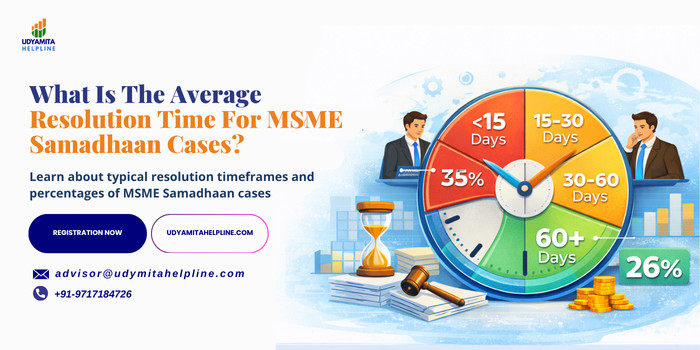
Delayed payments represent one of the main difficulties which Micro Small and Medium Enterprises MSMEs in India encounter. The government established the MSME Samadhaan portal as a solution to this problem which allows businesses to submit complaints against buyers who postpone payments. The most frequent question business owners ask about MSME Samadhaan cases is: What is the average resolution time for these cases?
The guide presents a complete analysis which describes the average resolution time for MSME Samadhaan Cases and all factors that affect the process together with useful knowledge to assist users in developing proper expectations.
Understanding MSME Samadhaan
The Ministry of MSME established MSME Samadhaan as an online platform which operates according to the Micro, Small and Medium Enterprises Development (MSMED) Act of 2006. The platform enables MSMEs to file complaints against buyers who fail to make timely payments and to obtain resolution through the Micro and Small Enterprises Facilitation Council (MSEFC). The platform establishes a 45-day payment period for buyers which they must meet or else face compound interest charges.
What is the Average Resolution Time for MSME Samadhaan Cases?
The average resolution time for MSME Samadhaan cases typically ranges between: 90 to 180 days (3 to 6 months)
However, this is an estimated timeline. In practice, some cases may be resolved faster, while others can take longer depending on various factors.
Legal Timeline as per MSMED Act
As per the MSMED Act:
- Cases should ideally be resolved within 90 days from the date of reference.
- The Facilitation Council first attempts conciliation.
- If conciliation fails, the matter proceeds to arbitration.
Despite this legal mandate, delays can occur due to administrative or procedural reasons.
Factors Affecting MSME Samadhaan Case Resolution Time
Several factors influence how quickly a case is resolved:
- Complexity of the Case: The process of resolving simple cases with direct evidence and contractual agreements proceeds without delays. The process of resolving disputes about quality issues and delivery problems and contract interpretation matters requires more time to complete.
- Availability of Documents: Proceedings face delays because of missing documents. The process of verification and decision-making becomes more efficient through strong documentation.
- Response from the Buyer: The buyer will respond faster to requests which results in quicker case resolution. The buyer will cause case delays and extended proceedings through their decision to ignore notices.
- Workload of the MSE Facilitation Council: Different states have different numbers of cases which they must handle. States with high pending cases will experience more delays in processing their cases.
- Conciliation vs Arbitration Stage: The process of conciliation normally requires less time to complete. The arbitration process needs more time because of its required hearing and formal legal procedures.
- Legal Challenges or Appeals: The buyer needs to go through the court system to contest the order which results in a significant extension of the resolution process beyond its standard timeframe.
Stage-wise Breakdown of MSME Samadhaan Timeline
The following shows approximate time requirements for each process step:
- Filing and Case Registration (1–2 weeks): The online application goes through a review process after submission, which leads to its delivery to the relevant authority.
- Notice Issuance to Buyer (2–4 weeks): The buyer receives a notification which requires him to answer the claim.
- Conciliation Proceedings (30–60 days): The two parties should reach a peaceful resolution which will solve their conflict.
- Arbitration Proceedings (30–90 days): Formal arbitration starts after conciliation fails, which includes hearing sessions and the assessment of evidence.
- Final Order and Execution (2–4 weeks): The council issues an award, which initiates the payment recovery process.
Why Some Cases Take Longer Than 6 Months
Although the expected timeframe is 3–6 months, delays beyond this period can happen due to:
- Non-cooperation by the buyer
- Multiple adjournments
- High backlog of cases
- Jurisdictional issues
- Court interventions
In such situations, cases may extend up to 9–12 months or more.
How to Speed Up MSME Samadhaan Case Resolution
You possess limited system control but can take actions that lead to quicker problem resolution. The following steps need to be completed for better processing of your request:
- Submit Complete Documentation: Include invoices, agreements, delivery proofs, and communication records.
- Follow Up Regularly: Stay in touch with the concerned Facilitation Council for updates.
- Respond Promptly: Attend hearings and reply to notices without delay.
- Avoid Errors in Application: Ensure all details (GST, PAN, buyer info) are accurate.
- Seek Professional Help: Consult legal or MSME experts if your case is complex.
Benefits of Filing Under MSME Samadhaan
Despite the timeline, MSME Samadhaan offers several advantages for its users which include
- The MSMED Act provides legal protection for the system
- The system calculates interest for delayed payments which includes compound interest
- The system offers an online process which maintains complete transparency
- The system requires no expensive court costs
- The system provides quicker resolution times than most traditional legal processes which take more time to complete
Realistic Expectations for Businesses
If you’re planning to file a case, here’s what you should realistically expect:
- Best case: 2–3 months (simple cases)
- Average case: 3–6 months
- Complex case: 6–12 months
Setting the right expectations helps you plan your cash flow and business operations accordingly.
Conclusion
The average resolution time for MSME Samadhaan cases needs to be determined. The law requires case resolution within 90 days but actual resolution time ranges from 90 days to 180 days depending on case complexity and party cooperation. MSME Samadhaan functions as a quick and effective solution which helps MSMEs to handle their issues with unpaid invoices. Your process will continue at a faster pace when you present correct documents and maintain active participation during your learning of the procedure.
FAQs
1. Is the MSME Samadhaan faster than court cases?
Yes, it generally is faster than the archaic courts of law whose proceedings usually drag on for years.
2. Can a case be resolved within 90 days?
Yes, but only simple cases with full support from both sides could achieve such a quick resolution.
3. Is resolving a case prescribed beyond one year possible?
Yes, certainly, in complicated cases or disputed cases, particularly in such cases where appeals are eventually made.
