

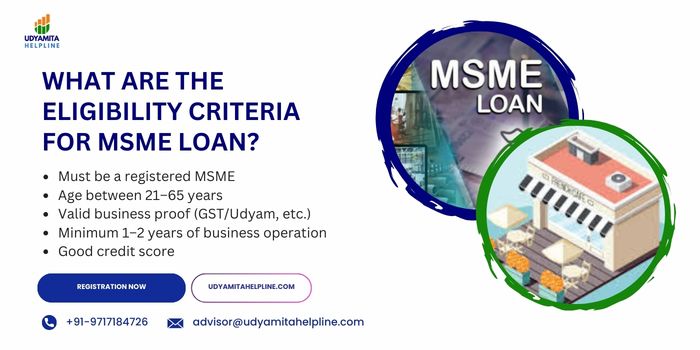
MSME loans serve as an essential funding resource for small enterprises throughout India. The Government of India together with financial institutions established simplified MSME loan regulations to improve funding access for entrepreneurs and startups and traders and manufacturers and service providers.
This article explains all requirements needed to qualify for MSME loans through its detailed explanation of eligibility criteria for MSME loan and MSME classification and required documents and available loan types and interest rates and approval tips.
Understanding MSME Loans in India
An MSME loan is a business loan offered to enterprises classified as Micro, Small, or Medium Enterprises under government guidelines. The loans exist to assist businesses with their development needs and operational requirements and their long-term success. MSME loans can be used for:
- Working capital and daily operational expenses
- Purchase of machinery or equipment
- Business expansion or infrastructure setup
- Technology upgrades
- Inventory and raw material procurement
Banks and NBFCs and government-backed institutions provide MSME loans with competitive interest rates and flexible repayment options.
Types Of MSME Loans And Its Eligibility Criteria
Below is a structured explanation of different types of loans and their eligibility criteria for MSME loans.
1. Term Loan for MSMEs
Used for long-term requirements such as business expansion, infrastructure development, or purchasing fixed assets.
Eligibility Criteria
- Business operational for 1–3 years (varies by lender)
- Stable revenue and profitability
- Acceptable credit score (generally 650 or above)
- Valid business registration (Udyam, GST, etc.)
2. Working Capital Loan
Helps manage daily operational expenses like inventory, salaries, rent, and utilities.
Eligibility Criteria
- Active business operations
- Consistent cash flow
- Bank statements (usually last 6–12 months)
- GST returns or turnover proof
3. Mudra Loan (PMMY)
Supports micro and small enterprises under the Pradhan Mantri Mudra Yojana.
Loan Categories
- Shishu: up to ₹50,000
- Kishore: ₹50,001 to ₹5 lakh
- Tarun: ₹5 lakh to ₹10 lakh
Eligibility Criteria
- Non-corporate businesses (proprietorships, partnerships)
- Small traders, manufacturers, service providers
- No major loan defaults
- Basic business proof
4. Collateral-Free MSME Business Loan
Get unsecured business loan without pledging property or assets.
Eligibility Criteria
- Good credit history
- Minimum turnover as per lender norms
- Business vintage of at least 1 year
- Strong banking record
5. Equipment or Machinery Loan
Purchase, upgrade, or replace machinery and business equipment.
Eligibility Criteria
- Machinery quotation or invoice
- Business registration and operational proof
- Repayment capacity assessment
- Equipment relevant to business activity
6. Invoice or Bill Discounting
Provides instant liquidity by financing unpaid customer invoices.
Eligibility Criteria
- B2B or B2G business model
- Valid tax invoices
- Creditworthy customers
- GST compliance
7. Startup Loans for MSMEs
Financial support for newly established businesses and early-stage startups.
Eligibility Criteria
- Registered startup or MSME
- Business plan or financial projections
- Promoter background and experience
- Co-applicant or guarantor (in some cases)
8. Government-Backed MSME Loans (CGTMSE)
Collateral-free loans backed by a government credit guarantee.
Eligibility Criteria
- Udyam-registered MSME
- New or existing business
- Viable and bank-approved business model
- Satisfactory credit appraisal
Documents Required for MSME Loan
Meeting eligibility criteria alone is not sufficient. Proper documentation is essential for verification and approval.
Personal Documents
- PAN card of the applicant
- Aadhaar card or other valid identity proof
- Address proof
Business Documents
- Udyam registration certificate
- Business registration documents
- GST registration certificate (if applicable)
- Business address proof
Financial Documents
- Bank statements for the last 6 to 12 months
- Income tax returns
- Profit and loss statements
- Balance sheets
- GST returns
Additional Documents
- Business plan or loan purpose note
- Ownership or partnership agreements
- Collateral documents (if applying for a secured loan)
Submitting accurate and complete documents helps reduce processing time and rejection risk.
Additional Initiatives for MSMEs in Budget 2025
The Union Budget 2025 introduced several supportive initiatives to strengthen MSME access to credit:
- Expanded Credit Guarantee Coverage under CGTMSE
- Interest Subvention Schemes for priority MSME sectors
- Digital MSME Credit Platform for faster approvals
- Special Fund for Women & SC/ST Entrepreneurs
- Green MSME Financing for sustainable businesses
- Enhanced Mudra Loan Limits for high-performing enterprises
These measures aim to reduce credit gaps and encourage inclusive MSME growth.
How To Apply For MSME Loan?
To apply for MSME loan you need to follow the following steps:
- Register your business on the Udyam portal
- Identify the loan type suitable for your business needs
- Compare lenders and interest rates
- Prepare required documents
- Apply online or through a bank/NBFC branch
- Complete verification and credit assessment
- Receive loan sanction and disbursement
Common Challenges in Meeting MSME Loan Eligibility
Here are the common challenges businesses faces in meeting the eligibility criteria for MSME loan:
- Low or no credit score
- Incomplete financial records
- Lack of formal business registration
- Irregular cash flow
- GST non-compliance
- Insufficient business vintage
Why Should MSMEs Apply for a Business Loan Through Udyamita Helpline?
Udyamita Helpline is a trusted MSME assistance platform that simplifies the loan journey. Key Benefits
- Free eligibility assessment
- Assistance with Udyam registration
- Multiple lender comparisons
- Faster loan approvals
- Dedicated MSME loan experts
- Support for startups and new businesses
Applying through Udyamita Helpline reduces rejection risk and saves time for entrepreneurs.
MSME Classification Applicable
The process of determining eligibility requires understanding the criteria which classify businesses as MSMEs. The Ministry of Micro Small and Medium Enterprises establishes MSME definition which all enterprises must follow according to their investment and turnover thresholds.
- Micro Enterprises: The business requires less capital to operate at which point it becomes operational.
- Small Enterprises: The business needs between 10 to 50 employees and operates with revenue between 50 to 250 million.
- Medium Enterprises: The business needs between 100 to 500 employees and operates with revenue between 250 million to 1 billion.
The classification process becomes necessary for businesses because multiple lenders and government programs mandate MSME certification as a requirement.
Conclusion
The Eligibility criteria for MSME loans exist to protect responsible lending practices while enabling companies to achieve genuine business development. Businesses need to establish their legal existence and financial stability and positive credit history and operational reliability to achieve qualification. The combination of government initiatives and Budget 2025 reforms and Udyamita Helpline expert platforms has created the most accessible MSME financing solution in history.
FAQs
Who Is Eligible To Apply For An Msme Loan In India?
Any business classified as a Micro Small or Medium Enterprise with valid registration and operational proof can apply.
Is Udyam Registration Mandatory For MSME Loans?
Most banks and government schemes prefer Udyam registration but it is not legally required in all situations.
What Is The Minimum Business Age Required For MSME Loans?
Most lenders require a business vintage of at least 1 year although startup-specific schemes may allow new businesses.
What Credit Score Is Required For An MSME Loan?
A credit score of 650 or higher is the standard requirement but some government programs such as Mudra do not enforce this rule.
Are MSME Loans Available Without Collateral?
Yes many MSME loans provide collateral-free options especially for Mudra loans and CGTMSE-backed loans.
Is GST Registration Compulsory For MSME Loans?
GST becomes necessary when business turnover surpasses the established threshold or when the lender demands it for evaluation purposes.
Can Startups Apply For MSME Loans?
Startups can use Mudra loans, startup loan programs and specific bank products to apply when they have a business plan.
