

MSMEs constitute the backbone of the Indian economy and make a significant contribution to GDP, exports, and job creation. One of the biggest challenges in the MSME industry is access to growth capital, especially equity capital.
To resolve this issue, the Indian government devised the concept of launching the Self Reliant India Fund (SRI), also known as the Fund of Funds for MSMEs, under the Atmanirbhar Bharat initiative. To work under this scheme you must be aware of its necessary information.
Here in this blog you will get to know everything about Self reliant India fund and via Udyamita helpline expert you can apply for this scheme easily.
What is Self Reliant India (SRI) Fund?
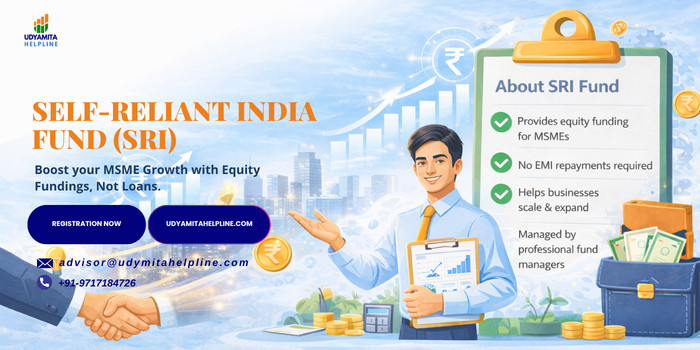
The Self Reliant India (SRI) Fund is a public scheme that aims at offering equity financing assistance for MSMEs in India.
This scheme is unique in that, unlike conventional loans, it emphasizes investing in business expansion without taking on additional debt.
Key Objective:
- Provide equity capital to MSMEs
- Support expansion and scaling
- Encourage listing on stock exchanges
- Boost India’s self-reliance
Key Highlights of Self Reliant India Fund
Following are some important aspects of the SRI Fund:
- Aggregate amount: ₹50,000 crore
- Investment by the government: ₹10,000 crore
- Runs as Fund of Funds (FoF)
- Promotes growth-oriented MSMEs
- Managed by professional fund managers
- Aims for the participation of the private sector
- Helps MSMEs grow and expand
Ready to Scale Your MSME?
Unlock equity funding through the SRI Fund—no loans, no repayment stress.
Start your SRI Fund journey with Udyamita Helpline today.
Who Can Apply for the Self Reliant India Fund?
The SRI Fund is designed for MSMEs that show strong growth potential. Here is the eligibility criteria:
- Must be registered as an MSME (Udyam Registration).
- Should be a growth-stage business, not just a startup.
- Must have a scalable business model.
- Should demonstrate financial viability.
- Preference for export-oriented or high-growth companies.
What Are The Benefits Of The Self Reliant India Fund?
The benefits of the SRI Fund are many and make it stand out as being unique to other MSME funds:
- No need for repayments: Gives equity financing, thus no EMI or repayments are required
- Growth of the firm: It assists MSMEs in growing their business
- Improving financial health: Strengthens the balance sheets
- Increased likelihood of financing: Makes it easier to borrow and get investments
- Lures investors: The government initiative adds confidence
How To Apply For A Self Reliant India Fund?
The Self Reliant India (SRI) Fund offers multiple advantages to MSMEs by focusing on equity-based funding rather than traditional loans. Here are the key benefits:
Step 1: Identify Daughter Funds Under the SRI Fund Scheme
The MSMEs will have to determine the registered daughter funds under the scheme of the SRI Fund because these are the funds investing in companies.
Step 2: Engage Venture Capital/Alternative Investment Funds
It is imperative for companies to approach VC/AIFs to show their requirement of funding under the scheme.
Step 3: Submission of a Detailed Business Proposal
It is compulsory for companies to come up with a comprehensive business plan which reflects their growth plans along with financial figures.
Step 4: Due Diligence by Fund Manager
A due diligence process will be conducted by the fund manager to ascertain the soundness of the business from financial and future growth perspectives.
Step 5: Finalizing the Investment
Upon satisfying all the conditions, the fund manager will decide to make an investment by injecting equity capital into the business.
What Documents Are Required For The Self Reliant India Fund?
To access funding through SRI Fund, MSMEs typically need:
Basic Documents:
- Udyam Registration Certificate
- PAN & Aadhaar of promoters
- Company incorporation documents
Financial Documents:
- Financial statements (last 2–3 years)
- Income tax returns
- Bank statements
Business Documents:
- Detailed business plan
- Growth and expansion strategy
- Pitch deck for investors
Additional Documents:
- GST returns
- Shareholding pattern
- Existing loan details (if any)
How Does The Self Reliant India Fund Work?
The Self Reliant India (SRI) Fund works through a three-tier structure:
Step 1: Government Fund (Mother Fund)
The government sets up the main SRI Fund with a fixed corpus.
Step 2: Investment in Daughter Funds
This fund invests in SEBI-registered daughter funds managed by professionals.
Step 3: MSME Funding
These daughter funds then invest directly in eligible MSMEs as equity.
Why is SRI Fund Important for MSMEs?
The SRI Fund plays a critical role in strengthening MSMEs by:
- Reducing dependence on loans
- Providing long-term capital
- Encouraging innovation
- Supporting global competitiveness
SRI Fund vs Other MSME Schemes
| Scheme | Type | Purpose |
| SRI Fund | Equity | Growth & expansion |
| CGTMSE | Credit guarantee | Collateral-free loans |
| ECLGS | Loan | Emergency liquidity |
| PMEGP | Subsidy | New business setup |
Challenges of Self Reliant India Fund
Despite its benefits, there are some limitations:
- Limited awareness among MSMEs
- Indirect application process
- Focus only on scalable businesses
- Investment depends on fund managers
Conclusion
Self Reliant India (SRI) fund is an innovative move towards development for MSMEs in India. With the provision of equity-based finance, this initiative helps to do away with the loan culture and promotes sustainable growth.
MSMEs in India, through appropriate planning and having good finances as well as a scalable model, can make use of this facility to take their businesses forward.
In line with the vision of making India a self-reliant nation, this fund would play a significant role in the future.
FAQs
What Is The Self Reliant India Fund?
It is a government-backed fund that provides equity funding to MSMEs for growth and expansion.
Is SRI Fund a loan scheme?
No, it provides equity investment, not loans.
Who can apply for SRI Fund?
Growth-oriented MSMEs with scalable and viable business models.
Can startups apply for SRI Fund?
Primarily growth-stage MSMEs are targeted, but scalable startups may benefit.
