

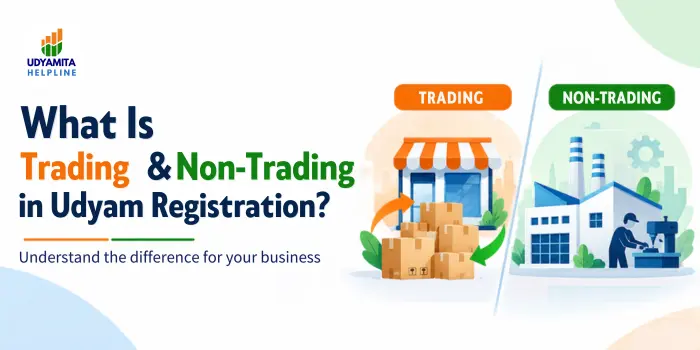
Halfway through the Udyam form, many applicants stop at one question: is my business “trading” or “non-trading”? A kirana owner wonders if selling groceries counts as trading. A web designer wonders what “non-trading” even means. A reseller who also repairs phones isn’t sure which box fits.
This guide explains udyam trading & non-trading in plain language. You’ll see what each term means, how they differ from manufacturing, how to choose, and what registration does and doesn’t give you.
What Is Udyam Registration?
Udyam Registration is the Government of India’s online system for recognising Micro, Small and Medium Enterprises (MSMEs). It is run by the Ministry of MSME, it is free, and it gives your business a permanent Udyam Registration Number (URN) and an e-certificate. It replaced the older Udyog Aadhaar system from 1 July 2020.
Whether you count as micro, small or medium depends on your investment in plant, machinery or equipment and your turnover. From 1 April 2025 the limits are:
| Category | Investment up to | Turnover up to |
| Micro | ₹2.5 crore | ₹10 crore |
| Small | ₹25 crore | ₹100 crore |
| Medium | ₹125 crore | ₹500 crore |
The portal fills in investment and turnover from government records, so you don’t pick the category yourself.
What Is Trading in Udyam Registration?
Trading means buying finished goods and selling them without making or changing them. Your income is the margin between what you pay and what you charge. Typical trading businesses include:
- Retailers selling to the public, such as a grocery shop, clothing store or mobile shop.
- Wholesalers and distributors supplying goods to shops and other businesses.
- Dealers and stockists carrying a brand’s products for a region.
- Resellers and online sellers who source products and sell them through their own site or a marketplace.
If you buy 200 shirts from a Surat manufacturer and sell them from your shop in Jaipur, that is trading. The same applies if you buy phones in bulk and sell them online.
What Is Non-Trading in Udyam Registration?
On the Udyam form, “non-trading” is the option for service businesses that earn by doing work rather than reselling goods. It is a portal choice under Services, not a general legal category covering every kind of business. Your income comes from your skill, time or expertise. Common examples:
- Professional and consultancy services: chartered accountants, tax consultants, business consultants, architects.
- IT and software services: website development, app development, software support.
- Digital marketing and advertising: SEO, social media management, ad campaigns.
- Education and training: coaching centres, skill-training institutes.
- Repair and maintenance: mobile repair, appliance servicing, equipment maintenance.
- Others: transport and logistics, event management, healthcare services.
A digital marketing agency in Pune earns from monthly retainers. A web developer in Indore earns from project fees. Neither is reselling a product.
Difference Between Udyam Trading & Non-Trading
| Factor | Trading | Non-Trading (Services) |
| Meaning | Buying and selling goods without changing them | Providing services or expertise |
| Main business activity | Purchase and resale of finished goods | Delivering work, advice or support |
| Source of income | Margin on goods sold | Fees, commissions or charges for services |
| Common examples | Grocery shop, wholesaler, online reseller | Consultant, IT firm, repair centre |
| Typical business model | Stock inventory, sell at a markup | Sell skills and time, often with little stock |
| Classification in Udyam | NIC 45, 46, 47; shown as Trading on the certificate | Service NIC codes; shown as Services |
| Check before selecting | Do you resell goods without changing them? | Does your income come from work done for clients? |
The one qualification: the benefits are not the same. The Ministry’s 2021 memorandum limits benefits for retail and wholesale trade MSMEs to Priority Sector Lending. Service enterprises are treated differently. Details are in the traders section below.
Trading vs Manufacturing vs Services in Udyam Registration
Udyam sorts business activity into three broad types.
- Trading is buying and reselling finished goods.
- Manufacturing is making or producing goods. It includes processing, assembling and converting raw material into something new. A bakery that bakes and sells bread is manufacturing. A shop that buys packaged bread and resells it is trading.
- Services is providing expertise, work or assistance to customers.
The business name doesn’t decide the category. “Sharma Enterprises” could be a trader, a manufacturer or a service provider. The work does.
Not sure whether your business counts as trading or services?
The team at Udyamita Helpline can walk you through your activity and NIC code before you submit. Visit UdyamitaHelpline.com to get started.
How To Choose Between Trading & Non-Trading in Udyam Registration?
Work through these steps in order.
- Write down what the business actually does: Skip the shop name or GST description and describe the daily work in one sentence.
- Decide the main nature of the work: Do you mainly sell goods you bought, make products yourself, or provide services?
- Match it to the NIC code: Udyam uses NIC 2008 codes at the five-digit level. A code like 47 or 62 alone isn’t enough, so look for the specific activity that fits. A cloth retailer would look under 47, a wholesale stationery dealer under 46.
- Handle mixed activity honestly: If you trade and also provide services, list both with their own NIC codes. Don’t choose one just to keep the form short.
- Check the live portal before submitting: Eligibility rules, NIC lists and portal options get updated, so verify against the current Udyam form.
Some competing guides say you can only ever select one. The official FAQ says multiple eligible activities can sit under a single registration, so report what you do.
Examples of Trading & Non-Trading Businesses
| Business | Likely activity type | Reason |
| Grocery shop | Trading (retail) | Buys packaged goods and sells them to customers |
| Clothing retailer | Trading (retail) | Resells finished garments |
| Wholesale distributor | Trading (wholesale) | Supplies goods in bulk to retailers |
| Online product reseller | Trading | Sources products and resells them online |
| Digital marketing agency | Services (non-trading) | Earns fees for marketing work |
| Website development company | Services (non-trading) | Earns project fees for building websites |
| Business consultancy | Services (non-trading) | Earns from advice and expertise |
| Repair service provider | Services (non-trading) | Earns for fixing and maintaining items |
Mixed businesses need care. A mobile shop that sells handsets and charges for screen repairs has both a trading and a service activity. Classification should reflect both, within the options the portal currently allows.
Can Traders Apply for Udyam Registration?
Yes, retail and wholesale traders can register. Before July 2021, NIC codes 45, 46 and 47 were excluded. A Ministry of MSME memorandum dated 2 July 2021 then allowed retail and wholesale trade to register on the Udyam portal. The same memorandum states that benefits for these enterprises are restricted to Priority Sector Lending.
Why Is Selecting the Correct Business Activity Important?
Your Udyam certificate is a record that banks, buyers and government departments may read. A correct entry helps in a few practical ways:
- Your activity and NIC codes match what the business really does.
- The record stays consistent with your GST and other business details.
- You avoid incorrect declarations and the work of correcting them later.
- You can check the specific conditions for any scheme or benefit against an accurate profile.
None of this means a wrong choice leads to automatic rejection or loss of benefits. It means a mismatched record can create questions and extra corrections, which are easy to avoid by getting it right at the start.
Common Mistakes to Avoid
- Choosing without understanding the term: Read what trading and services mean before ticking. If your income comes from resale, it is trading.
- Picking an unsuitable NIC code: Browse the code list under the right division and match your actual products or services. A leather goods seller shouldn’t use a household goods code.
- Confusing trading with manufacturing: If you make or change the product, even simply, you may be manufacturing. If you only resell it as bought, you are trading.
- Treating every service as identical: Accounting, IT and repair services have different NIC codes. Choose the one closest to your work.
- Ignoring secondary activities: If you do a second activity regularly, add it with its own NIC code.
- Assuming registration guarantees every MSME benefit: It doesn’t. Check the conditions of each scheme, and for traders remember the Priority Sector Lending limit.
Conclusion
Udyam trading & non-trading comes down to how you earn. Trading means buying and selling goods as they are. Manufacturing means producing goods. Service businesses earn by doing work for customers, and on the Udyam form this is the option usually called non-trading.
Your business name doesn’t decide the category, and neither does a competitor’s choice. Your actual activities do, including any secondary ones. Pick the NIC code that matches them, and remember that registration is not a guarantee of every MSME benefit, especially for traders.
If you’d like help working out the right activity and NIC code, or want to read more on Udyam Registration, visit UdyamitaHelpline.com. Our team can help you check your details before you apply.
FAQs
Trading means buying goods and selling them without making or changing them. Retailers, wholesalers, distributors and resellers fall here.
It is the portal option for service businesses that earn fees rather than margins on goods, such as consultants, IT firms and repair providers. It is not a general classification for all businesses.
Trading earns from reselling goods. Non-trading earns from providing services. The two also differ in NIC codes and in what benefits apply.
Yes. Retail and wholesale trade (NIC 45, 46, 47) has been allowed since the Ministry’s memorandum of July 2021, with benefits limited to Priority Sector Lending. Confirm on the live portal.
Yes, if it buys finished goods and sells them as they are. Retail trade falls under NIC division 47.
In the Udyam context, yes. Businesses earning from consultancy, IT, marketing, training or repair choose the service route.
Pick the five-digit NIC 2008 code closest to your actual work. A retail clothing shop looks under division 47, a wholesaler under 46, and a service firm under the matching service division.
Yes. One enterprise gets one Udyam Registration, and multiple eligible activities can be added with their NIC codes.
No. For retail and wholesale traders the Ministry limits benefits to Priority Sector Lending. Check each scheme’s conditions.
Yes. Log in to the Udyam portal and use the update option to change details such as NIC codes and activities. Updating is free.
