

If you run a small business in India, you already know the pain of waiting for payments that never come. You supply goods, complete the work, raise the invoice — and then follow up for months. Sometimes years. And the buyer? They just keep stalling.
The good news is, the Government of India has finally built a proper digital solution for this. It is called the MSME ODR Portal — and it lets you file case in MSME ODR Portal from your home or office without stepping into any court. In this guide, we will walk you through exactly how it works, who can use it, and what steps to follow.
What Is the MSME ODR Portal?
The MSME ODR Portal (also called the Smart ODR portal) is a fully online, end-to-end dispute resolution platform launched by the Ministry of Micro, Small and Medium Enterprises (Ministry of MSME) on 27 June 2025 — MSME Day. You can access it at odr.msme.gov.in.
ODR stands for Online Dispute Resolution. The portal was built specifically to help Micro and Small Enterprises recover unpaid dues from buyers — whether those buyers are private companies, government agencies, or large corporates.
This is not just a complaint portal. It is a complete legal mechanism that takes your case from the initial filing stage all the way to a legally binding award — without you ever needing to attend a physical hearing.
Key Fact: From 15 October 2025, all new delayed payment cases must be filed exclusively on the MSME ODR Portal. The old MSME Samadhaan portal (launched in 2017) no longer accepts new filings. It only shows the status of cases filed before that date.
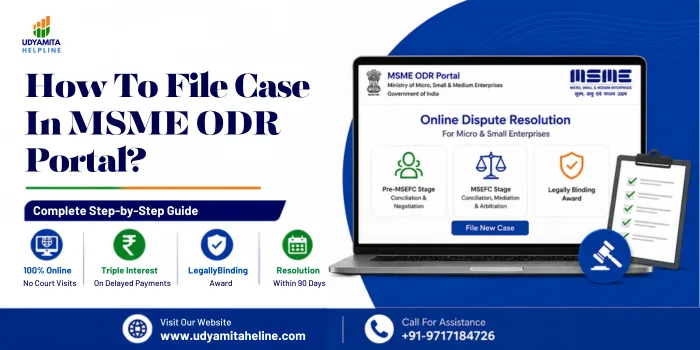
The Smart ODR portal works in two stages:
- Pre-MSEFC Stage — A voluntary digital negotiation and conciliation process where parties try to settle without formal proceedings.
- MSEFC Stage — If the above fails, the case moves to the Micro & Small Enterprises Facilitation Council (MSEFC) for formal conciliation, mediation, or arbitration under the MSMED Act, 2006.
There are 161 MSEFCs across India to handle these disputes. The council is mandated to decide the case within 90 days.
Who Can File Case In MSME ODR Portal?
Not every business can use this portal. Here is a quick eligibility checklist before you start:
| Eligibility Criteria | Details |
| Udyam Registration | Your business must have a valid Udyam Registration Number (URN) — registered before the disputed invoice date |
| Enterprise Type | Only Micro and Small Enterprises qualify. Medium enterprises are excluded from delayed payment provisions |
| Nature of Transaction | You must have supplied goods or services to the buyer under a valid contract or purchase order |
| Payment Delay | Payment must be delayed beyond the agreed period or the statutory limit — typically 45 days from the date of acceptance |
| Claim Period | The claim should be within the applicable limitation period under law |
Important: If you do not yet have Udyam Registration, get it first at udyamregistration.gov.in — it is free and takes just a few minutes.
Documents You Need To File Case In MSME ODR Portal
Before you sit down to file case in MSME ODR Portal, keep these documents ready. Missing even one of them can delay your case or lead to rejection.
Mandatory Documents:
- Udyam Registration Certificate (URN)
- Copy of Work Order, Purchase Order, or Agreement
- Invoice(s) raised on the buyer (with dates and amounts)
- Proof of delivery or service completion (delivery challan, completion certificate)
- Aadhaar card and bank account details of the business owner
Additional Supporting Documents (Highly Recommended):
- Email trails or written payment reminders sent to the buyer
- Any partial payment proof (if the buyer paid some amount)
- GST returns or tax invoices
- Any legal notice sent before filing
- Authorization letter (if someone else is filing on your behalf)
Struggling With Unpaid Invoices And Delayed Payments?
At Udyamita Helpline, we have helped thousands of MSMEs across India navigate the ODR filing process and recover their dues.
How To File Case In MSME ODR Portal?
Here is the complete MSME ODR portal registration process, broken down simply:
Step 1: Visit the Official Portal
Go to odr.msme.gov.in, the official MSME ODR Portal developed and owned by the Ministry of MSME under the RAMP (Raising and Accelerating MSME Performance) scheme.
Step 2: Register or Login
If you are a first-time user, register using your Udyam Registration Number (URN) and basic business details. If you already have an account, simply log in.
Step 3: Select “File New Dispute”
From your dashboard, click on the option to initiate a new delayed payment case.
Step 4: Enter Your Business Details
Fill in your enterprise name, Udyam number, enterprise category (Micro or Small), business address, PAN, GST number, mobile number, and email ID — exactly as per your official records.
Step 5: Enter the Buyer’s Details
Add the buyer’s full name, company or business name, address, GST number, email, phone number, and buyer category (private company, government body, etc.). Accuracy here is critical. Wrong buyer details can stall your entire case.
Step 6: Enter Transaction Details
Mention the contract or order value, date of supply, nature of goods or services supplied, the invoice amount, and the date from which the payment is delayed.
Step 7: Calculate Pending Amount and Interest
Enter the total pending amount. The portal will help you calculate interest at triple the RBI bank rate, which is the statutory interest rate on delayed payments under the MSMED Act, 2006. This interest alone can be substantial and often adds significant value to your total claim.
Step 8: Upload Documents
Upload all the mandatory and supporting documents in the required format. Double-check everything before uploading.
Step 9: Submit Statement of Claim
Prepare a brief written “Statement of Claim” explaining the facts — what you supplied, when, how much is owed, and how long the payment has been delayed. Keep it factual and clear.
Step 10: e-Sign and Submit
The portal may require Aadhaar-based e-sign for verification. Complete the digital signature step and submit your case.
Step 11: Get Your Acknowledgment Number
Once submitted successfully, you will receive an acknowledgment via SMS and email, along with a unique case or diary number to track the progress of your case.
What Happens After You File Case In MSME ODR Portal?
Here is how the process moves forward after your case is filed on the Smart ODR portal:
- Notice to the Buyer (15 Days) The portal automatically sends a formal notice to the buyer, giving them 15 days to respond.
- Pre-MSEFC Negotiation The portal first steers both parties into a digital negotiation or conciliation process — called the “Unmanned Negotiation” or “Digital Guided Pathway.” This is voluntary, and either party can opt out.
- MSEFC Stage (If Negotiation Fails) If no settlement is reached in the pre-MSEFC stage, the case is formally referred to the MSEFC. Conciliation proceedings begin — either party can attend virtually. If conciliation also fails, the council moves to statutory arbitration.
- Award Passed After hearings, the MSEFC passes an award specifying the total amount the buyer must pay — including the principal and interest.
- Buyer Must Pay Within 45 Days From the date of receiving the award, the buyer has 45 days to make full payment. If they fail to pay, additional interest and penalties kick in. The award is enforceable like a court decree.
- Closure Report Issued Once payment is received and confirmed, the portal issues a formal closure report, marking your case as successfully resolved.
Not sure how to calculate your interest claim or draft a Statement of Claim?
Our experts at Udyamita Helpline can guide you through the entire ODR filing process — for free.
Key Benefits of the MSME ODR Portal
| Benefit | What It Means for You |
| 100% Free to File | No court fees or filing charges for micro and small enterprises |
| Fully Online | No travel, no physical hearings, everything done from your office or home |
| Fast Resolution | MSEFC mandated to decide within 90 days |
| Legal Force | Awards are enforceable like a court decree |
| High Interest on Buyer | Buyer pays triple the RBI bank rate as interest on delayed payment |
| Tax Consequence for Buyer | Under Section 43B(h) of the Income Tax Act (from AY 2024-25), buyers cannot deduct delayed payments as expenses — adding real financial pressure on buyers to settle |
Common Mistakes to Avoid When Filing
- Wrong Udyam Registration Date: Your Udyam Registration must exist before the invoice date of the disputed transaction. If registered after, the claim may not be valid.
- Incomplete Buyer Details: Missing or wrong GST number or address of the buyer can delay the notice process.
- Missing Delivery Proof: Without proof that goods or services were actually delivered, your case becomes weak.
- Using Old Samadhaan Portal: From October 2025, new filings only go on the ODR portal at odr.msme.gov.in. Do not try filing on the old portal.
- No Interest Calculation: Many MSMEs forget to include the statutory interest in their claim. This can significantly reduce the amount you eventually recover.
Key Takeaways
- The MSME ODR Portal at is now the only place to file new delayed payment cases — the Samadhaan portal closed for new filings from October 15, 2025.
- Only Micro and Small Enterprises with valid Udyam Registration can file — Medium enterprises are excluded from this mechanism.
- The process includes a voluntary pre-MSEFC negotiation stage, followed by formal MSEFC conciliation and arbitration if needed.
- Buyers must pay within 45 days of the award — failing which interest and penalties apply.
- Under Section 43B(h) of the Income Tax Act, buyers face a direct tax disallowance if they delay payments beyond the statutory limit — making this mechanism even more powerful.
FAQs
No. The delayed payment provisions under the MSMED Act, 2006, apply only to Micro and Small Enterprises. Medium enterprises are not covered under this mechanism.
If the buyer does not respond or pay within 15 days of receiving notice, the case is forwarded to the MSEFC for formal conciliation and arbitration proceedings.
Smart ODR portal is another name used for the MSME ODR Portal at odr.msme.gov.in. It is a fully digital dispute resolution system launched by the Ministry of MSME on MSME Day, 27 June 2025.
The old Samadhaan portal no longer accepts new filings from October 15, 2025. It only allows you to track the status of cases that were already filed before that date. All new cases must go to odr.msme.gov.in.
The award passed by the MSEFC is enforceable like a court decree. If the buyer refuses to pay, you can initiate execution proceedings through the district court to recover the dues.
You do not legally need a lawyer to file a case. However, for complex disputes or larger claims, getting professional guidance can significantly improve your chances of a faster and higher recovery.
