

You pay salaries and suppliers on time, but what if your own buyer does not? Imagine a small auto-parts unit in Pune that delivers ₹8 lakh of goods to a large company. The supply is accepted and the invoices are raised. Four months later, the payment is still “under process.”
If this sounds familiar, MSME Act Section 18 is the provision you need to understand. It lets a party to a qualifying payment dispute approach the Micro and Small Enterprises Facilitation Council (MSEFC) instead of waiting years in a civil court. In this guide, we explain how it works, who can use it and what is actually in force today.
What Is MSME Act Section 18?
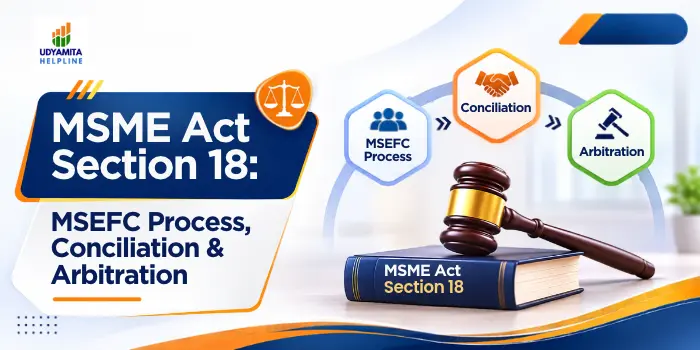
Section 18 of the MSMED Act, 2006 allows any party to a dispute over an amount due under Section 17 to make a reference to the Facilitation Council. The Council first attempts conciliation and, if that fails, arbitration.
A Facilitation Council is a body set up by the state government under the Act to resolve delayed-payment disputes. Parliament created this route because civil suits are slow, and small suppliers cannot carry unpaid invoices for years.
For fuller background, read our guide on understanding the Micro and Small Enterprises Facilitation Council.
Who Can Approach the Micro and Small Enterprises Facilitation Council?
The remedy is built for micro and small enterprise suppliers who have supplied goods or rendered services and are still unpaid. Medium enterprises do not get the delayed-payment remedies under Chapter V of the Act.
Udyam Registration matters. In Silpi Industries (2021) and Mahakali Foods (2022), the Supreme Court indicated that the supplier must be registered when the contract is made. In January 2025, in NBCC (India) Ltd v. State of West Bengal, a two-judge bench doubted this view and referred the question to a larger bench. From the sources we could find, that reference is still pending.
So compare your Udyam date with your contract and supply dates before filing. Registration alone does not settle eligibility. Check your enterprise category and confirm that the dues arise from goods or services you supplied.
How Does Section 18 of the MSMED Act Work?
The process has two stages: conciliation first, then arbitration if needed. This is the text currently in force.
Section 18(1): Reference to the Facilitation Council
Any party to the dispute may make a reference. In practice, you submit a written claim with your invoices and supporting papers to the Council. This applies despite other laws, and the Supreme Court held in Mahakali Foods that a reference is possible even if your contract has an arbitration clause.
Section 18(2): Conciliation Process
The Council either conducts conciliation itself or involves an institution providing alternative dispute resolution (ADR) services. Sections 65 to 81 of the Arbitration and Conciliation Act, 1996 apply. A neutral person helps both sides settle, for example on the principal and a negotiated interest amount. Nobody can force a settlement.
Section 18(3): Arbitration When Conciliation Fails
If conciliation ends without a settlement, the Council either takes up arbitration itself or refers the dispute to an ADR institution. The Arbitration and Conciliation Act, 1996 then applies as if the parties had signed an arbitration agreement. The Supreme Court has held that a Council that conducted conciliation can also act as arbitrator.
Section 18(4): Jurisdiction of the Council
The Council where the supplier is located has jurisdiction, even if the buyer is elsewhere in India. Say your unit is in Nashik, Maharashtra, and the buyer is in Delhi. The Maharashtra Council can deal with your reference, and you need not run to Delhi. Other statutory requirements still apply.
Section 18(5): Ninety-Day Timeline
Section 18(5) requires every reference to be decided within 90 days. That is the statutory target, not a promise that your case ends in 90 days. Missing paperwork, notices, adjournments and heavy caseloads can stretch the timeline. The Calcutta High Court has held that missing the deadline does not end the Council’s authority.
Status check (5 November 2026): The Mediation Act, 2023 would replace conciliation with mediation in Section 18, and the MSMED (Amendment) Act, 2026 adds new mediation and award deadlines. Neither is operative for Section 18 today. Notification S.O. 5575(E) of 12 October 2026 started most of the Amendment Act from 15 October, but Sections 8 to 10, which cover Section 18, the new Section 18A and Section 19, have no start date. We found no notification commencing the Mediation Act substitution. Check the Gazette before filing.
What Is the Difference Between Conciliation and Arbitration?
Conciliation tries to settle the dispute by agreement, while arbitration produces a binding decision.
| Point | Conciliation | Arbitration |
| Purpose | Amicable settlement | Binding decision on the dues |
| Nature | Informal, discussion-led, voluntary | Formal, with evidence and hearings |
| Role of the Council | Facilitator suggesting terms | Arbitrator, or refers to an ADR institution |
| Outcome | Settlement agreement | Arbitral award |
| If it fails | Moves to arbitration | Award can be challenged in court |
Stuck with an unpaid invoice?
Udyamita Helpline helps Indian MSMEs understand their options and prepare delayed-payment references.
How Is Section 18 Connected With Sections 15, 16 and 17?
These four sections work as one chain of protection:
- Section 15: The buyer must pay by the agreed date, never later than 45 days from acceptance or deemed acceptance. Read more on Section 15 of the MSMED Act.
- Section 16: Delayed payment attracts compound interest with monthly rests at three times the RBI bank rate. See interest on delayed MSME payments and how interest on delayed payments is calculated.
- Section 17: The buyer must pay the principal plus interest.
- Section 18: If the buyer disputes or ignores the dues, the matter goes to the Council.
How Can MSMEs Initiate a Delayed Payment Complaint?
You can start a complaint in seven steps:
- Calculate the dues: List unpaid invoices and compute principal plus statutory interest.
- Collect documents: Gather purchase orders, invoices, delivery challans, proof of service, acceptance records and payment reminders.
- Check Udyam details: Confirm your registration and its date.
- Identify the Council: It is generally the one covering your location as supplier.
- File through the official mechanism: Follow the current instructions on the portal.
- Respond to notices: Attend hearings and reply on time.
- Keep records: Save every email, notice and order.
Samadhaan, ODR and the Council are not the same thing. The MSEFC is the statutory body. Portals are only filing tools. From 15 October 2025, new delayed-payment references go through the MSME ODR portal (odr.msme.gov.in), launched by the Ministry of MSME. The older MSME Samadhaan portal redirects new filers and shows the status of legacy applications. Do not file a fresh case there. Our guide to the MSME ODR portal explains the screens, and you should confirm the process on the Ministry’s website.
What Happens If the Buyer Does Not Pay After the Council’s Decision?
An arbitral award can be enforced like a court decree under the Arbitration and Conciliation Act, 1996. The buyer may challenge it in court under Section 34 of that Act. Under Section 19 of the MSMED Act, 2006, the buyer must generally deposit 75% of the awarded amount before the court entertains the challenge, subject to the statutory terms.
Enforcement still takes effort and time. No one can promise automatic recovery or a fixed recovery period.
Important Things MSMEs Should Know Before Approaching MSEFC
- Keep proper invoices and delivery records.
- Preserve written communication with the buyer.
- Check Udyam Registration details and dates.
- Calculate dues and interest correctly.
- Verify territorial jurisdiction.
- Respond to Council notices on time. The Limitation Act, 1963 applies to these proceedings, so do not delay filing.
- Take professional advice if the buyer disputes the claim or raises legal objections.
Conclusion | How MSME Act Section 18 Helps Small Businesses Recover Their Dues
MSME Act Section 18 gives eligible micro and small suppliers a structured path: conciliation first, then arbitration, through a Council in their own state. It does not guarantee recovery, but it offers a faster, specialised forum than an ordinary civil suit.
Delayed payments choke working capital. Knowing your remedies helps you act early and with the right papers. If you need help with an MSME delayed-payment matter, explore the support at Udyamita Helpline or read our delayed-payment assistance guide.
Key Takeaways
- Section 18 covers disputes over dues under MSMED Act Section 17.
- Conciliation comes first; arbitration follows if it fails.
- The Council in the supplier’s location has jurisdiction.
- The 90-day limit is a statutory target, not a guarantee.
- New filings go through the MSME ODR portal.
FAQs
What is MSME Act Section 18?
It allows a party to a dispute over dues under Section 17 to refer it to the Facilitation Council for conciliation and then arbitration.
Who can approach the MSEFC?
Micro and small enterprise suppliers owed money for goods or services. Medium enterprises are excluded, and registration timing can affect eligibility.
What happens when conciliation fails?
The Council either arbitrates itself or refers the dispute to an ADR institution under the Arbitration and Conciliation Act, 1996.
Does the MSEFC have jurisdiction over buyers in other states?
Yes. The Council where the supplier is located can act even if the buyer is elsewhere in India, subject to statutory requirements.
Is there a 90-day timeline under Section 18?
Yes, Section 18(5) requires a decision within 90 days. In practice, delays can occur.
Is MSME Samadhaan the same as the Facilitation Council?
No. The Council is the statutory body. Samadhaan was a filing portal, now replaced by the MSME ODR portal for new cases.
