

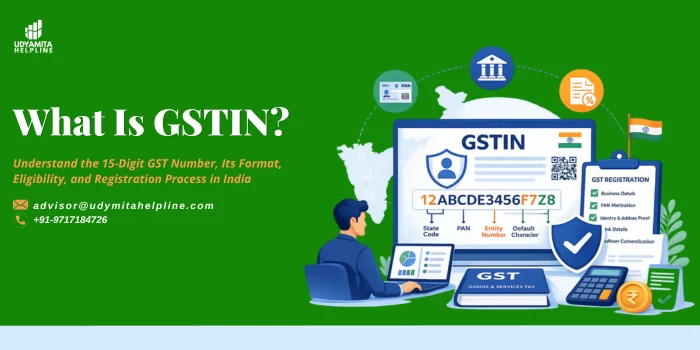
If you’ve started selling online, opened a shop, or crossed a certain turnover this year, someone has probably told you to “get your GST number sorted.” At Udyamita Helpline, we hear this question almost every day from small business owners across India — and most aren’t entirely sure what GSTIN actually means or why it’s so important. This guide breaks down everything: the meaning, the format, who needs one, and exactly how to apply.
What Is GSTIN?
GSTIN: Goods and Services Tax Identification Number — a unique 15-digit alphanumeric code issued to every business or individual registered under India’s GST system. This is your official tax identity.
Think of it as your business’s Aadhaar for tax purposes. This number is issued by the Goods and Services Tax Network (GSTN) once your registration is approved, and it’s based on your PAN (Permanent Account Number). Without it, you cannot legally collect GST from customers, claim Input Tax Credit (ITC), or file GST returns.
This identification system came into existence when GST replaced multiple indirect taxes — VAT, Service Tax, Central Excise, and state-level TIN numbers — on July 1, 2017, under the “One Nation, One Tax” reform. So whether you’re a kirana store owner in Jaipur, a garment exporter in Tirupur, or a freelance designer billing clients from Pune, your GST number is what makes you visible — and compliant — in India’s tax system.
A single business can hold more than one such number if it operates from multiple states, since registration is state-wise, not nationwide.
GSTIN Format and Structure Explained
Every GST number follows the same 15-character structure, and once you know how to read it, you can spot an obviously fake one in seconds.
| Position | Represents |
| Digits 1–2 | State code (as per the 2011 Census — e.g., 07 for Delhi, 27 for Maharashtra, 29 for Karnataka) |
| Digits 3–12 | The 10-digit PAN of the business or individual |
| Digit 13 | Entity/registration number — how many times the same PAN has registered in that state (1–9, then A–Z) |
| Digit 14 | A default character, usually “Z” |
| Digit 15 | A check digit, calculated using checksum logic to catch errors |
For example, a GST number like 27ABCDE1234F1Z5 tells you the business is registered in Maharashtra (27), its PAN is ABCDE1234F, this is its first GST registration in that state (1), and the final characters confirm the entry is valid. This self-verifying structure is exactly why even a single wrong digit can fail validation on the GST portal.
GSTIN vs GSTN vs GST Number — What’s the Difference?
This trips up almost every new business owner, so let’s clear it up once.
- GSTIN is your unique 15-digit identification number — the one printed on your invoices and registration certificate.
- GSTN (Goods and Services Tax Network) is the organisation that built and runs the IT infrastructure behind the entire GST portal — it’s the system, not your number.
- “GST number” is simply the everyday term people use for it. They mean exactly the same thing.
In short: when a vendor or client asks for your “GST number,” they want this 15-digit ID — not anything related to GSTN.
Who Needs a GSTIN? Eligibility and Turnover Limits
GST registration isn’t optional once you cross certain thresholds, and a few categories of businesses need to register regardless of turnover.
| Category | Threshold |
| Suppliers of goods | Turnover above ₹40 lakh (₹20 lakh in special category states) |
| Suppliers of services | Turnover above ₹20 lakh (₹10 lakh in special category states) |
| Voluntary registration | No minimum — you can register anytime to claim ITC and build credibility |
You must register regardless of turnover if you:
- Make interstate supplies of goods
- Sell through e-commerce platforms like Amazon or Flipkart
- Are a casual or non-resident taxable person
- Are liable to pay tax under reverse charge
- Are required to deduct or collect tax at source (TDS/TCS)
- Act as an input service distributor or agent on behalf of another taxpayer
Special category states (mostly in the Northeast and hilly regions) follow lower turnover thresholds, so it’s worth confirming your specific state’s limit before assuming you’re exempt.
Need help with your GST registration? Udyamita Helpline has helped thousands of Indian entrepreneurs get GST-registered the right way. 👉 Get Free Guidance Now
How to Apply for GSTIN — Step-by-Step Registration Process
Getting registered is completely free and fully online. Here’s exactly how it works:
- Visit the GST portal at gst.gov.in and click “Register Now” → “New Registration.”
- Fill Part A of Form GST REG-01 with your PAN, mobile number, email, and state. Verify these through OTP.
- Receive your TRN (Temporary Reference Number) once OTP verification is complete.
- Fill Part B using your TRN — business details, principal place of business, goods/services with HSN or SAC codes, and bank account details.
- Upload your documents as prompted by the portal.
- Complete Aadhaar authentication — this is now mandatory and speeds up approval significantly.
- Submit the application using a Digital Signature Certificate (mandatory for companies and LLPs) or EVC (OTP-based, for proprietorships and partnerships).
- Note your ARN (Application Reference Number) to track your application status.
- Get your GSTIN — once a GST officer verifies your application, you’ll receive your GST number along with the registration certificate (Form GST REG-06), usually within 3–7 working days for clean applications.
Documents Required for GST Registration
Keep these ready before you start the application — it saves you from resubmissions:
- PAN card of the business and the applicant
- Aadhaar card of the proprietor, partners, or directors
- Proof of business constitution (partnership deed, incorporation certificate, or registration certificate)
- Address proof of the principal place of business (electricity bill, rent agreement, or NOC from the owner)
- Bank account proof (cancelled cheque, bank statement, or passbook)
- Passport-size photographs of proprietor/partners/directors
- Digital Signature Certificate (mandatory only for companies and LLPs)
How To Verify a GSTIN Online?
Before you trust an invoice or onboard a new vendor, always verify their GST number. It takes thirty seconds and protects your ITC claims from fraud.
- Go to the official GST portal at gst.gov.in
- Click on “Search Taxpayer”
- Choose “Search by GSTIN/UIN” (or “Search by PAN” if that’s all you have)
- Enter the number and check the result
The portal will show you whether the registration status is Active, Cancelled, or Suspended, along with the registered business name and registration date. If the name doesn’t match what’s on the invoice, that’s a red flag worth following up on before you make any payment.
Benefits Of Holding A Valid GST Registration
Holding a valid one does more than keep you compliant — it actively helps your business grow:
- Legal authority to collect GST from customers
- Input Tax Credit (ITC) on your business purchases, lowering your effective tax cost
- Smooth return filing and valid invoicing without legal risk
- Stronger credibility with banks, vendors, and marketplaces — many won’t onboard you without one
- Eligibility for loans, government tenders, and interstate trade, all of which often require valid GST registration as proof of legitimacy
Common Mistakes and Penalties to Avoid
A few errors come up again and again with new registrants, and they’re easy to avoid once you know about them.
- Operating without mandatory registration: This attracts a penalty of ₹10,000 or 10% of the tax due, whichever is higher. For deliberate tax evasion, the penalty can go up to 100% of the tax due.
- Assuming one registration covers all states: It doesn’t. A business operating in multiple states needs a separate GST number for each one.
- Name mismatches: Your PAN name and business name must match exactly, or your application gets rejected.
- Skipping Aadhaar authentication: This delays approval and can trigger manual physical verification by a GST officer.
Key Takeaways
- GSTIN is your unique 15-digit tax identity issued after GST registration — mandatory for collecting GST, claiming ITC, and filing returns.
- The format encodes your state code, PAN, registration count, and a check digit for verification.
- GSTIN and GST number mean the same thing; GSTN is the separate organisation running the GST IT system.
- Goods suppliers above ₹40 lakh and service providers above ₹20 lakh must register, along with several mandatory categories regardless of turnover.
- GST registration is entirely free and done online through gst.gov.in.
- Always verify the number on the GST portal before trusting an invoice or onboarding a vendor.
Still have questions about GST registration?
Our experts at Udyamita Helpline are here to help — for free.
FAQs
Is GSTIN the same as a GST number?
Yes. GSTIN is the formal term, while “GST number” is just the everyday way people refer to it. Both mean the same 15-digit identification number.
What Is The Difference Between GSTIN & GSTN?
GSTIN is your unique tax identification number, while GSTN (Goods and Services Tax Network) is the organisation that built and operates the GST portal’s IT infrastructure. They are completely different things.
Is GST Registration Free?
Yes, getting your tax identification number through the official GST portal costs nothing. You may pay professional fees only if you hire a CA or consultant for assistance.
How Many Digits Are In A GST Number?
It always has 15 characters, combining your state code, PAN, registration count, a default character, and a check digit.
Can A Business Have More Than One GST Registration?
Yes. If your business operates in multiple states, you need a separate registration number for each state, even though your PAN stays the same.
How Long Does It Take To Get GST Registered?
Most clean applications with Aadhaar authentication are approved within 3–7 working days. Incomplete documents or failed authentication can extend this timeline.
What Happens If I Run A Business Without Required GST Registration?
You’ll face a penalty of ₹10,000 or 10% of the tax due, whichever is higher, and you cannot legally collect GST or claim ITC until you register.
How Can I Check If A GST Number Is Genuine?
Search for it under “Search Taxpayer” on gst.gov.in. A genuine, active registration will display the correct business name and an “Active” status.
