

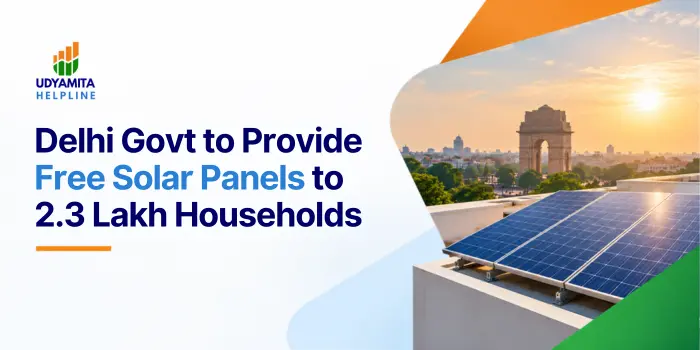
If your monthly electricity bill keeps climbing, this update is worth a few minutes. The Delhi government has amended its Free Solar Energy Policy so that eligible households using up to 400 units a month can get a rooftop system of up to 3 kW with no upfront installation cost. The Delhi free solar panel scheme aims to reach about 2.3 lakh households by March 2027. It is linked to the PM Surya Ghar: Muft Bijli Yojana, and installation depends on eligibility and roof feasibility.
Delhi Government Free Solar Panel Scheme | What Has Been Announced?
Delhi’s Cabinet approved the second amendment to the Delhi Solar Energy Policy on September 1, 2026. It was formally notified in the Delhi Gazette on September 17, 2026. Chief Minister Rekha Gupta said the central scheme had not gained enough momentum in Delhi, and this change is meant to fix that.
The main idea is simple. Central and Delhi subsidies, plus a state top-up where needed, cover the installation cost for eligible households. A note on numbers: the announcement mentioned 2.3 lakh homes, but the notified policy and the official portal say 2,20,000 eligible consumers, first-come, first-served. The portal also shows a scheme closing date of February 28, 2027.
Who Is Eligible for Free Rooftop Solar Panels in Delhi?
Free installation is not for every household. The notified policy sets these conditions:
- The household is a residential consumer.
- Its average monthly consumption in FY 2025-26 was up to 400 units. This is gross consumption, which includes any solar generation.
- It has not taken a solar subsidy earlier under PM Surya Ghar or the Delhi scheme.
- The roof is technically feasible for up to 3 kW.
The portal also says a household with more than 1 kW of solar already registered against its account is not eligible for this route. Group housing societies can benefit too. Households above 400 units can apply for up to 3 kW but must pay the net cost after subsidies. Verify your own status on the Delhi Solar Portal, which checks eligibility using your electricity account number.
How Much Subsidy Is Available Under PM Surya Ghar?
The Delhi Solar Portal lists the central subsidy for residential systems like this:
| Component | Central Subsidy |
| First 2 kW | ₹30,000 per kW |
| Additional capacity up to 3 kW | ₹18,000 per kW |
| Cap for systems of 3 kW or larger | ₹78,000 |
Delhi’s support is separate. The state adds a capital subsidy of up to ₹78,000, which is the lower of the tendered cost minus the central subsidy or ₹26,000 per kW. For households up to 400 units, Delhi also covers any remaining gap through a top-up.
How To Apply for Delhi Free Solar Panel Scheme?
The portal showed 43,383 applications on September 28, 2026. To apply:
- Open solar.delhi.gov.in and select “Confirm & Apply Now.”
- Enter your CA (consumer account) number, DISCOM name and mobile number, then verify the OTP.
- The portal checks your eligibility automatically.
- Choose a 2 kW or 3 kW plant and enter your district and pincode.
- Tick the consent box, submit and save your reference number.
The Delhi power generation company (IPGCL) is selecting vendors through a tender, which the portal says may take about 1.5 to 2 months. The selected vendor then visits your premises to check technical feasibility, and installs only if the site qualifies. Net-metering formalities are coordinated with the DISCOM. The portal guides I reviewed list no application fee or document uploads, so confirm current requirements on the site.
What Does “Zero Upfront Cost” Mean?
It means eligible households are not expected to pay for installation out of pocket. The subsidies are paid to the vendor after installation and commissioning, not handed to households as cash. The policy’s own example is a ₹1.75 lakh 3 kW system: the ₹78,000 central and ₹78,000 Delhi subsidies leave ₹19,000, which the state covers for the up-to-400-unit group.
“Zero upfront” does not mean free electricity or a guaranteed zero bill. Also, the Power Department owns the plant for five years while the household uses it. Ownership then passes to the consumer.
Five Years of Free Solar Panel Maintenance
The selected installing vendor must provide operation and maintenance for the first five years at no extra charge. After that, the electricity distribution company (DISCOM) can arrange maintenance with your consent, and the charges are added to your bill. This is voluntary, and you can arrange your own maintenance instead. Optional group insurance against fire, theft and weather damage is also planned, with the premium paid by you if you choose it.
Delhi’s Target: 2.3 Lakh Rooftops by March 2027
The government wants roughly 2.3 lakh rooftops and about 500 MW of added rooftop capacity by March 2027. Trade reports put Delhi’s existing base at only around 10,073 systems, so the target is steep. Delivery will depend on how quickly vendors, installers and DISCOM net-metering teams can scale up.
PM Surya Ghar vs Delhi Government Solar Support
PM Surya Ghar is the national rooftop solar programme. Delhi’s amended policy adds state-level support on top.
| PM Surya Ghar (Centre) | Delhi Policy | |
| Support | Up to ₹78,000 | Up to ₹78,000 plus top-up |
| Who gets it | Residential consumers nationwide | Eligible Delhi consumers |
What Are The Benefits For Delhi Households?
- Rooftop solar can help reduce electricity bills, depending on your usage and generation.
- The upfront installation burden is removed for eligible homes.
- Surplus power exported through net metering is credited or paid for. Trade reports say Delhi has cut residential net-metering time from about 75 days to 25 and waived fees up to 10 kW. Verify this on the portal.
- Five years of maintenance support is included.
- It adds to Delhi’s renewable capacity.
Existing electricity subsidies continue, according to the government. But subsidy eligibility is based on gross consumption, so solar generation counts toward the 400-unit limit.
Conclusion
Delhi’s revised policy could make rooftop solar accessible to households that couldn’t afford the upfront cost. Eligibility, roof feasibility and vendor rollout will decide who benefits. Before applying, check the Delhi Solar Portal for the latest eligibility, application status, deadlines and conditions.
Want to explore more government schemes for your home or business?
Udyamita Helpline is here to guide you about latest Government Schemes, for free.
Explore Free Resources
FAQs
Residential consumers with average consumption up to 400 units in FY 2025-26, who haven’t taken solar subsidy before, and whose roof is technically feasible.
Up to 400 units a month on average, counting gross consumption including solar generation.
Up to 3 kW. Applicants choose either 2 kW or 3 kW.
It is the Government of India’s rooftop solar scheme for households. The central subsidy is capped at ₹78,000 for systems of 3 kW or more.
Through the Delhi Solar Portal, using your CA number, DISCOM name and a verified mobile number.
Yes, for the first five years through the installing vendor. Later maintenance is voluntary and charged through your electricity bill.
